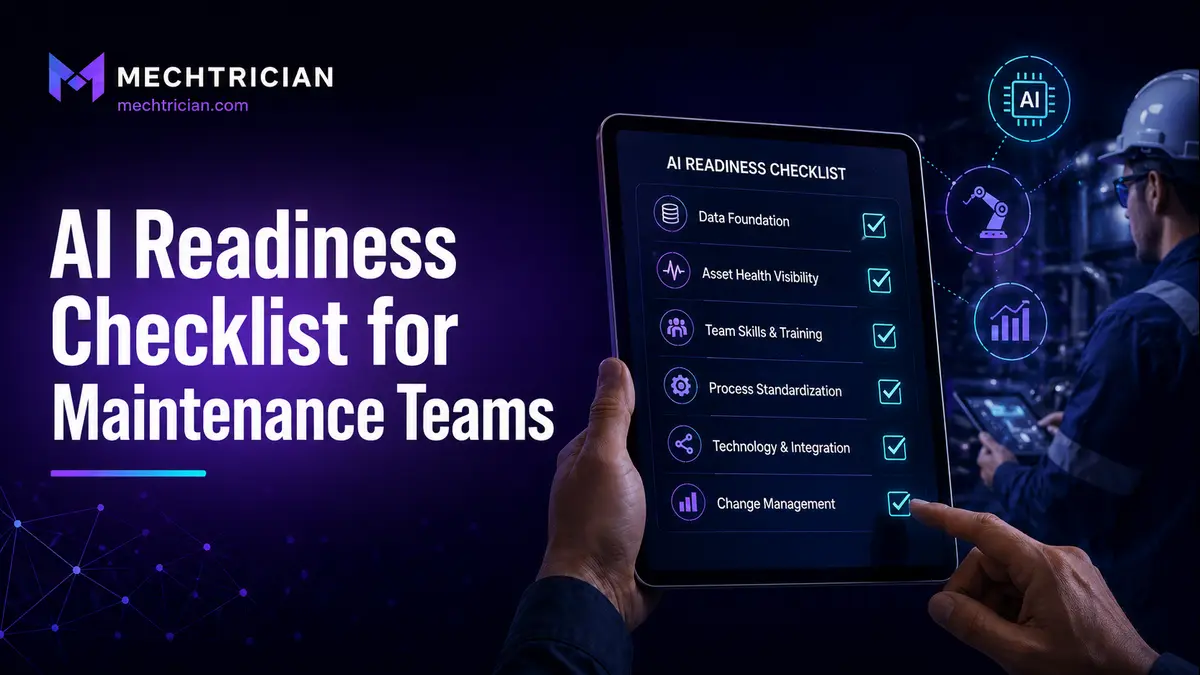
AI Readiness Checklist
for Maintenance Teams
Most maintenance teams don’t fail at AI because they chose the wrong software. They fail because the foundations weren’t in place — messy data, undocumented knowledge, unclear workflows. This checklist covers the 32 things your team needs to have sorted before AI can deliver real value.
Work through each section honestly. The gaps you find aren’t failures — they’re your roadmap. Every unchecked item is a clear, actionable step toward being AI-ready.
AI is only as good as the data it learns from. This is not a metaphor — it is the most consistent reason maintenance AI projects fail. Before any algorithm can predict failures, flag anomalies, or recommend actions, it needs clean, consistent, structured data to work with.
In most maintenance operations, CMMS data is a mess. Asset names are spelled differently by different technicians. Work orders are closed with a single word in the notes field. Failure codes either don’t exist or are applied so inconsistently they’re meaningless. Parts are logged against wrong assets or not logged at all. When AI tools try to analyse this data, they either produce garbage outputs or simply can’t run at all.
The 8 items in this domain don’t require any new technology. They require discipline — clear standards, consistent habits, and someone who owns data quality. Get these right first and every AI tool you adopt later will perform significantly better.
The number one AI use case in maintenance in 2026 is not predictive failure detection. It is knowledge capture and sharing — and that finding surprises most people who hear it. But it makes complete sense when you think about what maintenance teams actually struggle with day to day.
Every maintenance team has at least one person who “just knows” how the old compressor sounds before it gives trouble, or who remembers that the fix in the manual never actually works and the real solution is something completely different. That knowledge is worth more than any sensor. And when that person retires or leaves, it walks out the door forever — unless someone captured it.
AI tools can help you capture, tag, search, and surface this knowledge at the exact moment a technician needs it. But they can only work with what exists in a structured, documented form. The items in this domain are about creating that foundation — SOPs, troubleshooting guides, failure symptom logs, and root cause records that AI can actually use.
Here is a problem that never makes it into AI vendor brochures: 80% of organizations that already have sensors and monitoring tools still struggle to turn that data into clear action. The alerts fire. The dashboard lights up. And nothing happens — because nobody defined what should happen next.
AI cannot fix a broken workflow. If your team is mostly reactive today, adding AI on top of that will simply create more noise — more alerts, more recommendations, and more things being ignored because there’s no clear process for acting on them. The teams that get real value from AI are the ones that already have defined escalation paths, clear KPI ownership, and a culture of using data to make decisions.
This domain also looks at your planned vs reactive split. If more than half of your maintenance work is unplanned, that is a process problem before it is a technology problem. AI can accelerate a good maintenance process. It cannot substitute for one that doesn’t exist.
Technology adoption in maintenance fails more often for human reasons than technical ones. A sensor network with no buy-in from technicians becomes a system nobody trusts. A predictive maintenance tool purchased without a budget for training sits unused. An AI pilot with no leadership champion gets deprioritised the moment the next crisis hits.
Cultural readiness means leadership understands why AI matters for maintenance — not in a vague “innovation” sense, but in concrete terms: reduced downtime, lower parts costs, faster repairs. It means at least one person on your team is genuinely excited about AI and has been given the time and authority to drive adoption. And it means your technicians have been brought into the conversation early enough to see AI as a tool that helps them, not threatens them.
This domain is often the last thing teams think about and the first reason their AI projects stall. Address it early — especially leadership buy-in and the assignment of an AI champion — before committing significant budget to any tool.
A high score on this checklist doesn’t mean you’re ready to buy an AI platform tomorrow. It means your team has built the foundations that allow AI to deliver real, measurable value when you do invest. The difference between maintenance teams that get genuine ROI from AI and those that don’t almost always comes down to these four domains — not the sophistication of the tools they buy.
A low score isn’t a setback either. It’s a clear, prioritised action list. Every unchecked item in the High priority category is something you can start working on this week, with no new software and no additional budget. The most common mistake maintenance managers make is skipping this foundational work and jumping straight to an AI vendor demo. The result is an expensive tool that underperforms because it had nothing solid to build on.
The most effective way to use this checklist is not to fill it out alone. Bring your senior technician, your CMMS administrator (if you have one), and your maintenance supervisor into a 60-minute session. Go through each domain together. Where you disagree about whether something is genuinely complete — that disagreement itself tells you something important about gaps in your process.
Once you’ve identified your three weakest areas, assign an owner to each one and set a 30-day review date. Don’t try to fix everything at once. Focus on the High priority items in your lowest-scoring domain and work from there. Progress compounds — improving data quality makes knowledge capture easier, which makes your workflows more effective, which builds the cultural confidence for broader AI adoption.
Do I need a CMMS before I can use AI? Not necessarily, but without some form of structured digital maintenance record, most AI tools will have nothing to work with. Even a well-maintained spreadsheet of asset history is a starting point. A CMMS makes AI adoption significantly faster and more effective.
How long does it take to get AI-ready? For a team starting from scratch, expect 3 to 6 months of focused foundational work before AI tools start delivering consistent value. Teams with good CMMS hygiene and documented procedures can move much faster — sometimes running a meaningful AI pilot within 4 to 6 weeks.
Which AI use case should we start with? Start with the use case that solves your most painful current problem. If unplanned downtime on a specific asset is costing you significant money, predictive monitoring for that asset is your starting point. If your technicians waste hours searching for information, AI-assisted knowledge retrieval is the priority. Match the tool to the problem, not the other way around.
Can small maintenance teams use AI? Absolutely. Some of the most effective AI implementations are in mid-sized facilities with 5 to 15 person maintenance teams. Smaller teams often move faster precisely because they have less organisational inertia. The foundational work in this checklist applies equally regardless of team size.